Less Spiky CTC Alignment for Data Cleaning (2025–)
Motivation
- Open speech foundation models such as OWSM rely on large web-crawled corpora, whose transcripts are often misaligned with the audio.
- OWSM v4 cleans the YODAS corpus with CTC alignment [paper]
- Audio and text are re-aligned with CTC segmentation [paper] using a pre-trained OWSM-CTC model, which splits long recordings into utterances of up to 30 seconds.
- Each utterance gets a CTC confidence score, and the lowest-scoring 10% within each language are discarded (along with LID-based filtering).
- So, the quality of the cleaned data depends directly on how accurate the CTC alignment is.
Problem: CTC is Spiky
- CTC models output sharp, single-frame spikes for each token and predict blank for most of the frames.
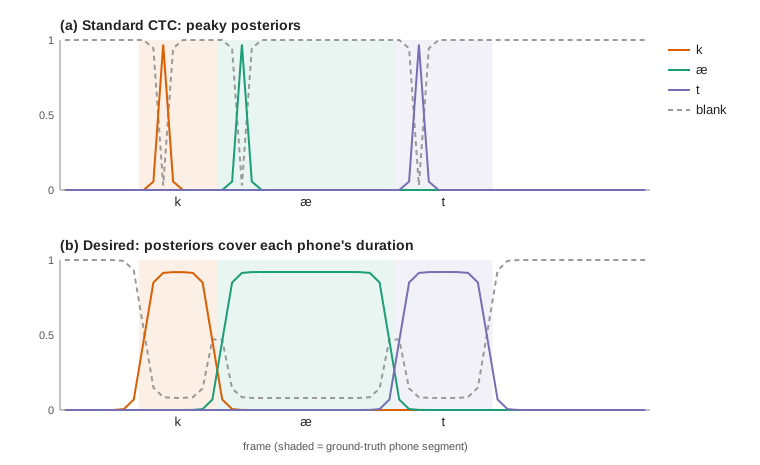
Illustration with synthetic posteriors. Shaded regions are the ground-truth phone segments.
- This is harmless for recognition, since the blanks are removed anyway, but the spike positions say little about where each token starts and ends.
- Zeyer et al. show that this peaky behavior comes from the CTC training criterion itself, not from the model architecture [paper]
- Starting from a uniform initialization, gradient descent on the CTC loss converges to peaky (and sometimes suboptimal) local optima.
- The blank label is what makes CTC converge well, but it is also what absorbs most of the frames.
- Training with a label prior removes the peaky behavior and improves convergence.
Previous Work: Label Priors
- Huang et al. apply label priors to CTC forced alignment [paper]
- During training, each frame’s posterior is divided by the label prior, ytπt / P(πt)α, so that alignment paths with fewer blanks get higher scores. (α = 0 is the standard CTC; α = 0.3 worked best.)
- The priors start from a uniform distribution and are re-estimated at the end of every epoch by averaging the model’s posteriors over all frames.
- The priors are also used in the Viterbi search for the alignment. Applying them only at decoding time, without training, did not help.
- Results (phoneme-level TDNN model trained on LibriSpeech)
- The blank prior on training data drops from 0.80 to 0.32, and the average phone duration grows from 21 ms to 64 ms. (Ground truth: 82 ms)
- Phoneme and word boundary errors are reduced by 12–40% on Buckeye and TIMIT compared to standard CTC and a heuristic offset baseline.
- It is close to the Montreal Forced Aligner on Buckeye but still behind it on TIMIT, while being much simpler to train and faster to run.
Proposed: BIE-CTC, an HMM-like Topology
- Label priors are a soft fix: they lower the blank bias, but the blank token itself is still ambiguous.
- In CTC, blank means both “silence” and “the previous token is still going on.”
- Also, repeated tokens (e.g., “e, e” in “see”) can only be separated by a blank.
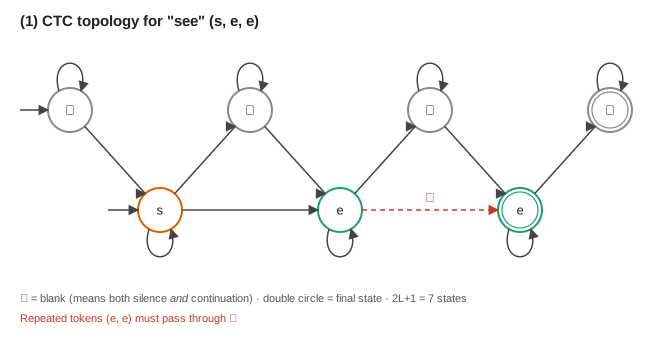
- Instead of a blank, each token gets an explicit 3-state structure, like the classic 3-state HMM.
B-x: the beginning (onset) of token x, with a self-loop of at most 1–2 framesI-x: the inside (steady state) of token x, with an unrestricted self-loopE-x: the end (offset) of token x, with a self-loop of at most 1–2 frames<sil>: an explicit silence token without phases, taking over the “silence” meaning of blank
- The graph for “see” (s, e, e), where
<sil> between tokens is optional and I-x can be skipped for very short tokens:
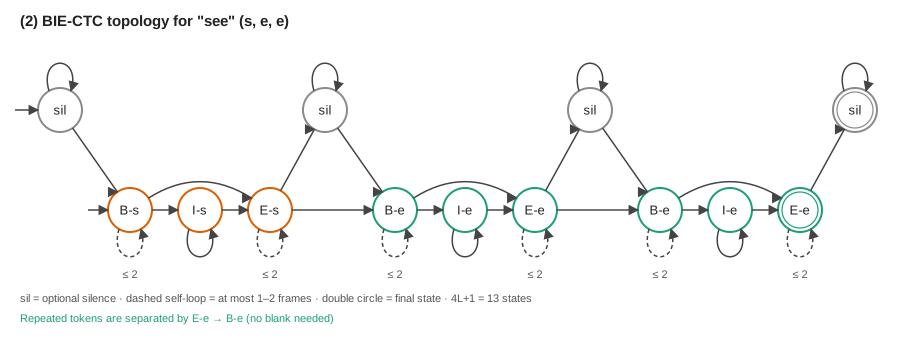
- Repeated tokens are separated naturally by the
E-e → B-e transition, so no blank is needed between them.
- Factored output head
- A joint output layer would triple the vocabulary from V+1 to 3V+1.
- Instead, a token head (V tokens +
<sil>) and a phase head (B, I, E) are trained together, with P(token, phase) ≈ P(token) × P(phase). <sil> is masked out of the phase head.
- This saves 2V−3 output units, at the cost of an independence approximation.
- Since the B and E states give the onset and offset directly, BIE-CTC could also help with:
- streaming (the E state as an emission signal)
- compressing CTC outputs for speech LLMs
- duration modeling (the length of the I state as a differentiable duration)
Open Questions
- Minimum duration: each token needs at least 2 frames (B + E), compared to 1 frame in CTC. This may hurt fast speech, so should a token be allowed to take a single frame?
- The factored head assumes that the token and the phase are independent, which is only an approximation.
- The forward-backward algorithm must be rewritten. The standard CTC trellis has 2L+1 states, while BIE-CTC has 4L+1, so the existing CTC losses in ESPnet or k2 cannot be used as is.
- Chorowski et al. found that frame-level normalization with context-dependent CTC symbols overfits and needed utterance-level normalization [paper]. The same may apply to the larger BIE output space.
Experiment Plan
- Main claim: more accurate forced alignment
- Baselines: (1) standard CTC, (2) CTC with label priors, which BIE-CTC must beat
- Ablations: factored vs. joint output head, mandatory vs. optional I state
- Data: LibriSpeech for training and WER, TIMIT for alignment
- Metric: phoneme boundary error (PBE, ms)